Your business has a new employee starting in a few weeks, and your team gives its technology provider plenty of notice.
- The employee’s name, role and start date are supplied.
- A laptop is requested.
- The user onboarding checklist begins.
But important questions can still remain unanswered.
- Which projects will the person work on?
- Which Teams, SharePoint sites and shared mailboxes will they need?
- Which specialist AEC applications should be installed?
- Who approves access to sensitive client or project information?
- What does their manager expect them to be able to do on their first morning?
The problem is not that someone forgot the checklist - or submitted it too late.
The problem is that successful user onboarding is more than a checklist.
It is a collaborative business process.
Three people every business process needs to handle
Most businesses talk about onboarding and offboarding. A stronger process also recognises the important changes that happen between those two events.
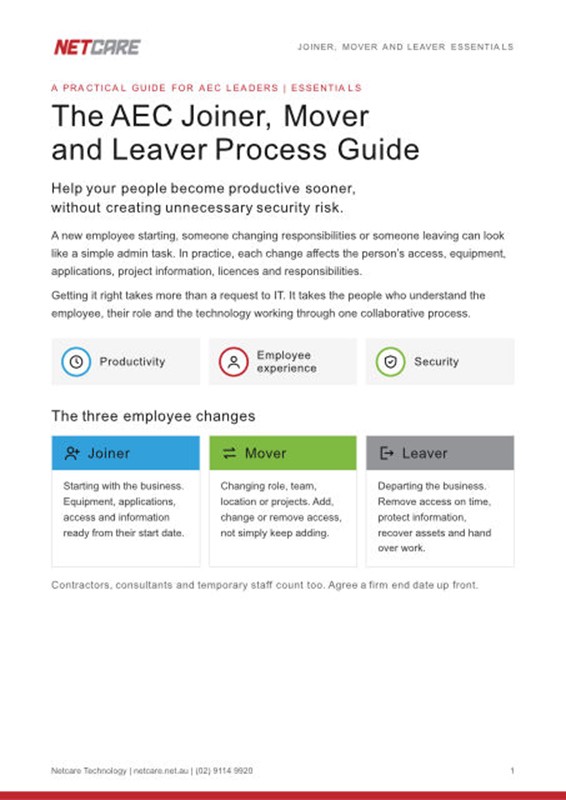
- A joiner is someone starting with the business.
- A leaver is someone leaving the business.
- A mover is someone changing role, team or access internally.
Each event changes what a person should be able to access, which tools they require, which information they handle and what the business expects them to do. The technology tasks may look different, but the underlying requirement is the same: the right people need to share the right information, make the right decisions and confirm the right outcome.
A completed checklist does not always mean the person is ready
For an AEC business, preparing a user involves much more than creating an account and supplying a computer.
A joiner may need access to current project files, Microsoft Teams, SharePoint sites, shared mailboxes, client information and specialist design, engineering, construction or project management applications. The correct setup depends on their role, projects, responsibilities and level of authority.
A mover creates a similar challenge. A promotion, transfer to another project team or change in responsibilities can mean the person needs new access - but may also mean that old access should be removed. If the process focuses only on adding what has been requested, permissions can accumulate over time without anyone stepping back to confirm what is still appropriate.
A leaver raises another set of questions. Disabling the main user account may be one task, but what happens to project files, email, client communication, business devices, specialist applications, subscriptions and the responsibilities the person leaves behind?
No single person necessarily holds all this information.
The manager understands the role. Administration or HR knows the employment details. Finance may manage purchasing and licences. Operations understands the project environment. Netcare knows how to configure and secure the technology.
A checklist can record the tasks.
A collaborative process brings together the people who know what those tasks should be.
The business pain appears in three places
Lost productivity
Productivity is usually the most visible pain.
A joiner can have a computer and user account but still be unable to contribute because project access, applications, permissions or shared resources are missing. Their manager loses time following up. Colleagues create workarounds. The employee waits while the business pays for time that should have been productive.
Movers can experience the same friction. They begin a new role but retain the technology setup of the old one, leaving them unable to perform new responsibilities efficiently.
A poor employee experience
The first day gives a new employee an immediate impression of how organised the business is. When everything is ready, they can focus on the role, the team and the work. When it is not, their first experience is uncertainty and delay.
The final days matter too. A well-managed departure helps colleagues understand what is changing, ensures responsibilities are transferred and allows the leaver to exit professionally. A fragmented process can leave the remaining team searching for information, reconstructing decisions and explaining gaps to clients or project partners.
Security and commercial risk
Joiners, movers and leavers all change the business’s access risk. A joiner should receive enough access to perform the role - but not more than required. A mover’s access should reflect the new position rather than simply accumulating. A leaver’s access should be removed at the right time across the systems the business uses.
When ownership is unclear, accounts, third-party applications, shared credentials, devices or subscriptions can be overlooked. Project and client information may remain accessible to the wrong person, while the business may have no clear record showing what was reviewed and completed.
The checklist is necessary - but it is not the process
A good checklist is valuable. It creates consistency, supports documentation and helps prevent routine tasks from being missed.
But a checklist cannot decide what a person’s role requires. It cannot identify a project responsibility that was never communicated. It cannot resolve conflicting instructions, obtain an approval or confirm that the employee can actually perform the job.
The checklist must sit inside a broader process with a clear trigger, defined responsibilities, complete information, approvals, dependencies, escalation when something is missing and final confirmation of the business outcome.
In other words: The checklist tells people what to do.
The process ensures the right people work together to decide what needs to be done - and whether it worked.
Client experience: collaboration drives improvement
From my perspective, the teams from both companies have worked very well together and we are seeing massive benefits and improvements from this.
Stephen Allan, Director, Edgewater Connections
Stephen’s feedback followed improvements across the wider technology experience. It captures the same principle that makes joiner, mover and leaver processes successful: better outcomes happen when the business and its technology partner work as one team.
A better approach: one collaborative process
At Netcare, we believe the process should begin with the business event - not with an isolated IT task. The aim is to make the transition productive, secure and clear for everyone involved.
- Start with the business outcome: Confirm whether the person is a joiner, mover or leaver, along with the effective date, role, manager, work location, responsibilities, project involvement and expected outcome.
- Bring together the people who hold the information: The manager, administration or HR, operations, finance and Netcare each contribute different knowledge. Responsibilities and approvals should be clear rather than assumed.
- Translate the role into technology requirements: Convert the agreed business needs into the appropriate device, Microsoft 365 access, Teams and SharePoint access, shared mailboxes, AEC applications, licences, permissions and security controls.
- Confirm completion and the business outcome: The process finishes when the responsible people confirm that the joiner or mover can perform the role - or that the leaver’s access, assets, information and responsibilities have been handled correctly.
What a successful process looks like
Imagine a joiner arriving with the right equipment, applications and project access ready for their role. Their manager knows what has been completed, the employee can contribute sooner and the business creates a confident first impression.
Imagine a mover beginning the new role with access that reflects current responsibilities - not a growing collection of permissions inherited from every previous position.
And imagine a leaver’s final day being handled with the same discipline: access removed at the right time, devices and subscriptions accounted for, project knowledge transferred and the business able to confirm that the process is complete.
The result is not just smoother IT administration. It is a business that is more productive, more secure, more professional and easier to scale.
Your next step
If your current approach depends on forms, emails, memory and follow-up conversations that are not connected through one process, the answer is not simply a longer checklist.
Download the AEC Joiner, Mover and Leaver Process Guide.
It will help you identify who needs to be involved, what information should be shared and how managers, administration and IT can work through one collaborative process.
Because a successful employee transition is not measured by how many boxes were ticked. It is measured by whether the person - and the business - was ready for what happened next.
Considering a change of IT service provider?
Netcare can help you assess the complete service model - including response, resolution, communication, employee experience and technical alignment to a documented standards library.
To discuss this topic, call us now on (02) 9114 9920 or .